 0800 026 6985
Review goes here!!
Category: Uncategorized
When we think of a crane, we picture a loud, urban landscape with a lanky, yellow structure manoeuvring large objects high into the sky. For the most part, this is the environment cranes are resigned to. Yet, sometimes, these pieces of machinery disregard stereotypes to leave us picking our jaws up off the floor.
Outside of the construction sites, cranes have created some spectacular, death-defying moments from base jumping to conducting scientific research on the moon. So, besides from constructing a building, what can you do with a crane?
Hold A Protest

In total Jackass fashion, stuntman Steve-O revolutionised the traditional ‘peaceful sit-in’ by clambering up a 100ft crane in protest of SeaWorld. Recording the whole ordeal on Facebook, Steve-O and his small, inflatable Orca grabbed headlines all around the world with one of his most dangerous stunts yet. A subsequent night in jail seemed worth it for the cause, however, as the hashtag ‘#SeaWorldSucks’ trended worldwide, forcing the Orlando aquarium to halt their Orca breeding programme.
Steve-O and the Jackass crew have performed hundreds of meaningless stunts over the last 15 years, but this may just have been their most significant.
Test The Limits Of The Body

David Blaine has pushed his body right to the very edge on multiple occasions to wow his audiences, yet one of his oldest stunts is still his most famous. Back in 2003, the American magician and illusionist imprisoned himself in a plexiglass box for 44 days, with only 4.5 litres of water a day to keep him company. Suspended by a crane on the doorstep of Tower Bridge, Blaine pushed the limits of the human body right to the very edge, drawing huge crowds for each of the 44 days.
As Crane uses go, this is one of the most extraordinary.
Explore Space

For as long as science as a concept has existed, mankind has strived to push the boundaries of exploration and research. This desire for knowledge eventually lead scientists to the moon back in the 60’s and ever since then, a number of tests and research projects were carried out to further our understanding of our neighbouring planets.
The invention of the lunar crane has long been a major tool when studying the moon, collecting rocks and gathering materials for scientific research. In terms of the most meaningful crane uses, researching the solar system has provided scientists with a greater understanding of our galaxy.
Make A Hit YouTube Video

The internet is littered with videos that make you laugh, cry and cringe. But when two Russian free climbers ascended the crane atop of the Shanghai Tower, it created a video which will make any viewers’ palms’ instantly sweaty. With no harnesses in sight, these two daredevils stroll along the 650ft high crane without a care in the world. The resulting footage has become one of the most watched videos on the platform, racking up an impressive 62 million views.
While cranes have their uses, none of the others are as perilous than this. But hey, anything for a like, ey?
Fuel Your Inner Adrenaline Junkie

What is the one thing you need for base jumping? Height! (And a parachute, you’ll need one of those too). Cranes offer the perfect platform for anyone looking to base and bungee jump, and NMT have recently provided a 700-tonne crane for the annual World Base Jumping competition.
If you fancy yourself as a stuntman/daredevil/lunatic, then base jumping off a 90ft crane offers the perfect platform to get your kick.
Build The World’s Tallest Building

Ever since the crane was invented, humans have had a desire to build taller and taller and taller. The end result is the 2,700ft monument that looms over the Emirati desert. The building is so tall that crane operators live in their cranes for a whole working week, as the time it takes to descend the tower would leave them with only a few hours before they make the climb again.
The desire to build bigger is one of the purest crane uses there are, and who knows? Perhaps in a few years, architects will construct a building even taller than the Burj Khalifa.
Film A Blockbuster Movie

Cranes may not be synonymous with movie sets, but they have been used to capture some of the most iconic shots in film and TV history. Construction work and industrious work may be the most common of crane uses, but these huge pieces of machinery also offer a certain degree of subtlety and creativity when needed.
If you are in the process of filming the next Oscar-nominated flick, or if you need a crane for any one of these projects, contact NMT Crane Hire today to speak to one of our operators.
NMT let Jeremy Clarkson drive their Mobile Tower Crane
rnrn rnrnNMT recently allowed Jeremy Clarkson to drive their Speirings AT6 tower crane. rnrnThe crane was used to set up a stunt where Clarkson drops James May’s piano onto a car.rnrnThe driver was actually in control up top but it looked like Clarkson was operating the crane by remote control.rnrnPlease watch on our video gallery page.
The Science Behind Tower Cranes
The Science Behind Power Cranes
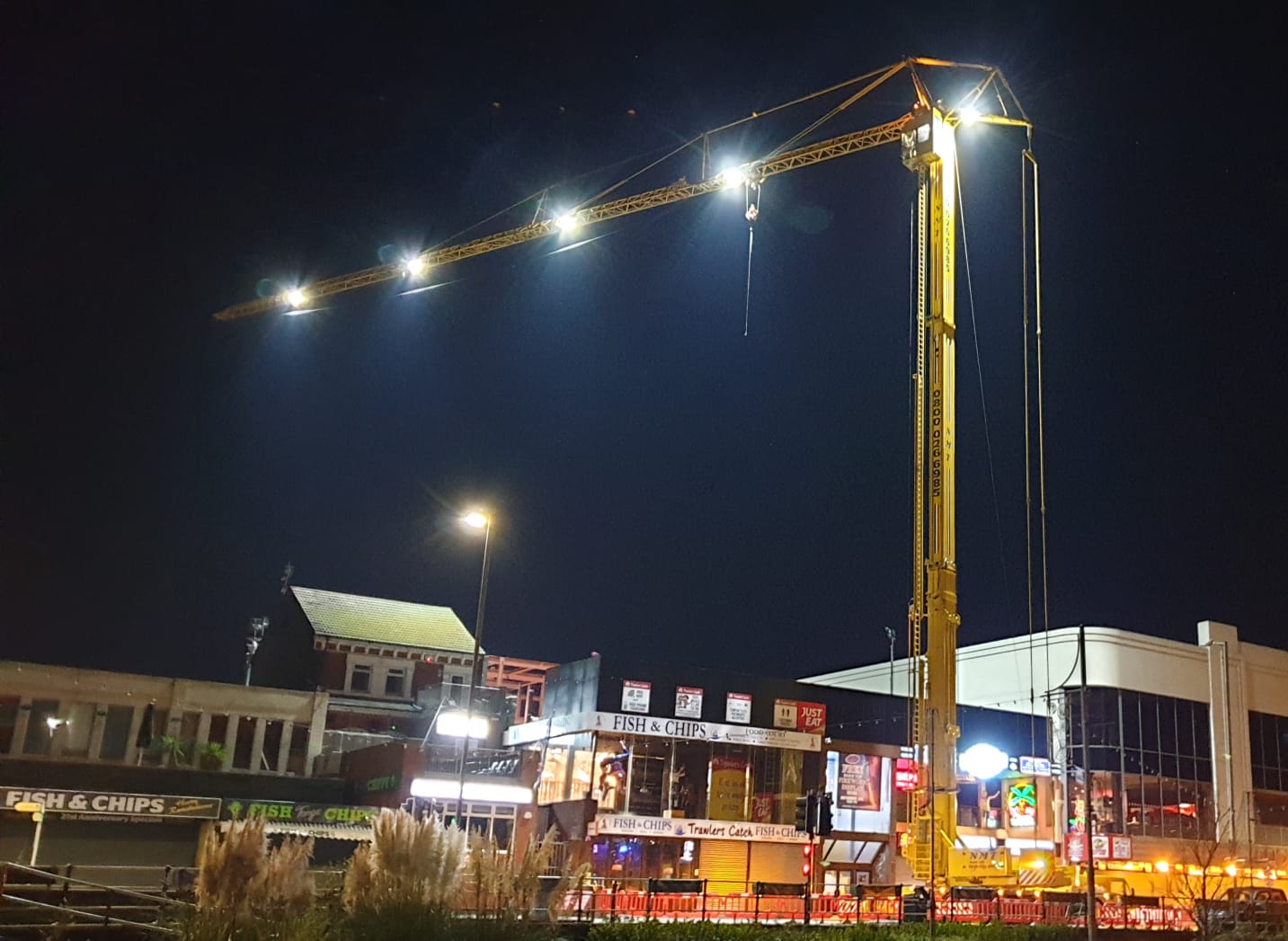
If you have marvelled at a tower crane and asked yourself “how do those things work?” don’t worry, you are not on your own. A feat of engineering, tower cranes have been at the forefront of construction and innovation for centuries, yet knowledge of their mechanics and their functionalities are still reserved for experts and practitioners. To shed light on this industry, NMT Crane Hire study the science behind tower cranes.
Foundations For Tower Cranes
One of the most important aspects in ensuring a crane strays upright is making sure a suitable foundation has been laid. Like any building or skyscraper, a foundation needs to be sewn in order to secure the structure and to prevent any mishaps. Typically, a foundation for a tower crane will be secured with cement (again, like a building or skyscraper) and in certain cases, steel beams will be used for added security to the structure. The usual formatting of a crane’s foundation will consist of the base of the crane being attached to a concrete pad via large anchor bolts. Following on from this step, the pad will be connected to the steel beams, which are reinforced with concrete pillars. This foundation gives the crane a wider base platform, and as it is secured with concrete, this significantly reduces the chances of any tower crane toppling, even in extreme conditions. Modern-day cranes and their foundations are built to withstand winds of up to 145mph, meaning they should comfortably deal with category 4 hurricanes and storms.
Counterbalancing
Another vital component of a tower cranes structure is the counterbalance. Evidently, tower cranes are not built to just stand up and look pretty; they are responsible for manoeuvring large materials at great heights. When operating heavy materials at height, one of the main concerns is the risk of toppling, and that is why tower cranes are usually fitted with a counterweight. However, the equation for working out how much weight is needed for a specific load is far more sophisticated than one would think. Here is the equation in full to help you determine the appropriate counterbalance weight for your crane:
Step 1: Determine the amount of weight being applied to one end of your crane
Step 2: Measure the distance between the weight and the pivot point
Step 3: Multiply the amount of weight by the distance between the two points
Step 4: Measure the distance of the opposite side of the level (the space which is available for the counterbalance.)
Step 4: Divide the total applied torque (the force which causes the rotation) by the distance of the counterbalance weight.
How Heavy Can They Lift?
As mentioned in the equation above, the amount of counterbalance required depends on the weight of the materials. As cranes are required to lift high and to lift big, just how heavy can they haul? The maximum unsupported height for a crane is around 265 feet, but this height can increase if the crane is attached to the side of a building. With that in mind, the typical tower crane offers a lifting power of around 19.8 metric tonnes. As previously explained, this amount of weight changes depending on the height of the crane, the conditions in which the crane is lifting and a number of other variables, and with a number of safety concerns, it is important to air on the side of caution when deciding how you load your tower crane.
NMT Crane Hire are experts in the field of crane hire, so if you wish to find out more about all of our services, contact us today on 0800 026 6985 or leave us a message via our online contact form.
Testing the review form
What Is Heavy Haulage and When Do You Need It?
What Is Heavy Haulage and When Do You Need It
The grand statue of a tower crane is a symbol of sheer height, yet the whole process of constructing and transporting a crane to a new site is synonymous with size. For a big piece of machinery like a crane, you need an accommodating delivery service that can transport the largest objects both safely and efficiently. Heavy haulage is a specific industry that has been tailor-made for oversized objects such as cranes; the industry is an essential piece of the puzzle in sculpting our skyline.
What is Heavy Haulage?
The classification behind heavy haulage stretches further than the size of your object. There are a number of categories that diagnose your load with specific speed limits and weight restrictions. Category 2 and 3 vehicles, which is where the majority of heavy haulage vehicles reside, are limited to 40 mph on motorways and 35 mph on dual carriageways, and depending on the precise weight of the vehicle, you may need to be granted permission to transport the goods.
Heavy Haulage Weight Restrictions
With loads exceeding a gross weight of 78 tonnes, you will need to inform the Highway and Bridge Authorities with at least 2 clear days of notice. The same goes for loads over 147 tonnes, except in this case, the notice period is extended to 5 days and the Police must also be informed. There are a number of categories that require notice and special permission, so to familiarise yourself with all these guidelines, take a look at the Special types enforcement guide.
Despite the rules and regulations, heavy haulage is not an exclusive industry. Although this method of transportation is mainly reserved for agriculture, construction and in the delivery of static homes, there is a reason why so many companies opt for one big haul over multiple journeys with smaller lorries. Although the premium of heavy haulage may exceed the costs of smaller delivery options, the cost of multiple trips will soon add up to one higher than a single, larger service. This method is also less time consuming, and allows all the parts of a crane, for example, to be delivered in a more timely fashion, speeding up the entire construction process. Heavy haulage is only an option to consider if your use of a crane conforms with a CPA contract, where you will need to provide everything but the crane for your build.
If you are in the process of constructing all the parts to your latest build and need a crane transported to your site, you can call on the services NMT Crane Hire to deliver the goods. Just contact us on 0800 026 6985 or you can use our online form to leave us a message.

rn rnrn rnrn rnrn rnrn rnrn rnrn rnrnNMT Crane Hire were recently called in to lift a very delicate old aircraft.rnrnThe fusalage of the vintage comet was lifted into position for a museum
40th year with new depot and 500 ton Crane


NMT perform complex rig & lift with AC700 and AC250
NMT supplied their 700 ton Terex for a complex lift,which involved aerial rigging the 36 metre luffing jib at a site in Snetterton,Norfolk.rnrn Although it was a awkward set up and involved a 250 ton crane as the rigging crane,the crane was ready to work in less than 8 hours.
How to Operate a Crane in Bad Weather
How to Operate a Crane In Bad Weather
Operating a crane is a job which requires nerves of steel and an eye for precision at the best of times, yet when this profession is combined with adverse weather conditions, the job requires a whole other level of expertise. As we head into the colder months, NMT Crane Hire explains how to operate a crane when the weather takes a turn for the worst?
Strong Winds
Unsurprisingly, the most pressing issue presented to crane operators is strong winds. Being such tall and slender obstacles, strong winds pose an imminent threat to the stability of a crane. Despite being equipped with counterweights of varying sizes to cope with different conditions, cranes are typically restricted to lifting in conditions in excess of 20 mph. The typical industry practice will see most lifts postponed if winds creep up to and around the 15 mph mark to err on the side of caution.
Due to the stature and structure of a crane, there is no definitive answer as to how to operate a crane is windy conditions. The general rule of thumb will be to wait until the wind settles as health and safety is the priority of any lift.
Thunder and Lighting
When storms are brewing, there are a number of other problems which must be considered by crane operators. Although there are no official guidelines which offer guidance for operating in thunder and lighting, it is generally advised to abandon any lifting once thunder is detected at least 10 miles away. If the last sighting of thunder has been detected 10 miles away, the very next strike could be in your location, no matter if it is raining or not. As cranes are large metal structures, they are more likely to be struck by lightning as they are conductors of electricity, which is why abandoning the crane once thunder and lightning have been detected is advised. Do not return back to the cockpit of the crane until 30 minutes has passed since the last thunder strike. Again, it is better to be safe than sorry.
Contact
For more information on how to operate a crane or other industry-relevant topics, head over to our news page. If you wish to learn more about our services, contact NMT Crane Hire on 0800 026 6985 or leave us a message via our online contact form.